
Are Life Insurance Payments Tax Deductible?
Life insurance is a financial tool that helps protect families from unexpected loss. Many people wonder if the payments for life insurance—also called premiums—are tax deductible. The answer is not always simple. The tax rules depend on who owns the policy, who pays the premiums, and the reason for the insurance. In this article, you’ll learn how the tax rules work for life insurance payments in the United States, plus some tips and common mistakes to avoid.
What Does “tax Deductible” Mean?
A cost is tax deductible if you can subtract it from your income when you file your taxes. This lowers your taxable income, so you pay less tax. For example, some people can deduct mortgage interest or student loan interest. But not every payment you make is tax deductible. The IRS has rules about what you can and cannot deduct.

Are Life Insurance Premiums Tax Deductible For Individuals?
Most people buy life insurance for personal reasons. They want to help their family if something happens to them. But if you pay for your own life insurance policy, the IRS does not let you deduct the premiums from your personal income taxes.
Here’s why:
- The government sees life insurance as a personal expense, not a business or investment cost.
- The payout (death benefit) is meant to support your family, not to help you earn money or run a business.
So, if you pay $50 or $200 per month for your own policy, you cannot deduct these payments on your federal tax return.
Example
If you pay $1,200 per year for a life insurance policy, you cannot subtract this $1,200 when you do your taxes. Your taxable income does not change.

Are Life Insurance Premiums Tax Deductible For Businesses?
For businesses, the rules are different. Sometimes, businesses buy life insurance to cover key employees or business partners. Whether or not the premiums are deductible depends on the policy’s purpose.
When Premiums Are Not Deductible
Most of the time, if a business is the beneficiary of the policy (meaning, the business gets the money if the person dies), the premiums are not deductible. The IRS treats this as a business benefit, not a cost of doing business.
When Premiums Might Be Deductible
There are some cases when businesses can deduct life insurance premiums:
- The policy is part of an employee benefit plan (like group-term life insurance).
- The employee owns the policy, and the business pays the premiums as part of their salary or benefits.
In these cases, the IRS allows deductions because it is seen as part of employee compensation.
Comparison Table: Business Vs. Personal Deduction Rules
| Situation | Premiums Tax Deductible? | Who Gets the Benefit? |
|---|---|---|
| Personal life insurance (individual) | No | Family/beneficiaries |
| Key person insurance (business is beneficiary) | No | Business |
| Group-term life (employee benefit) | Yes, up to $50,000 coverage per employee | Employee’s family |
Special Cases: Group Life Insurance And Executive Benefits
Some employers offer group-term life insurance as a benefit. Here’s how the tax rules usually work:
- The business can deduct premiums for group-term life insurance up to $50,000 of coverage per employee.
- If coverage is more than $50,000, the employee might have to pay income tax on the value of the extra coverage.
- If the policy is for an owner or executive, and the company is the beneficiary, premiums are not deductible.
Example
A company pays for $30,000 of group life insurance for an employee. The premium is tax deductible for the business. If the company pays for $100,000 of coverage, the value of coverage above $50,000 is considered extra income for the employee and may be taxed.
What About Life Insurance In Divorce Or Alimony?
Sometimes, a divorce agreement requires one ex-spouse to buy life insurance to protect alimony or child support payments. People often wonder if these premiums are tax deductible.
- The IRS does not let you deduct premiums paid for a policy that benefits your ex-spouse or children, even if court-ordered.
- The only exception is if the payments are structured as alimony, and the insurance is owned by the ex-spouse receiving the alimony. In most cases, however, premiums are not deductible.
Are Life Insurance Payouts Taxable?
While the focus here is on payments (premiums), it’s helpful to know that death benefits paid to beneficiaries are usually not taxable income. For example, if your family receives $500,000 from a life insurance policy, they usually do not pay federal income tax on that money.
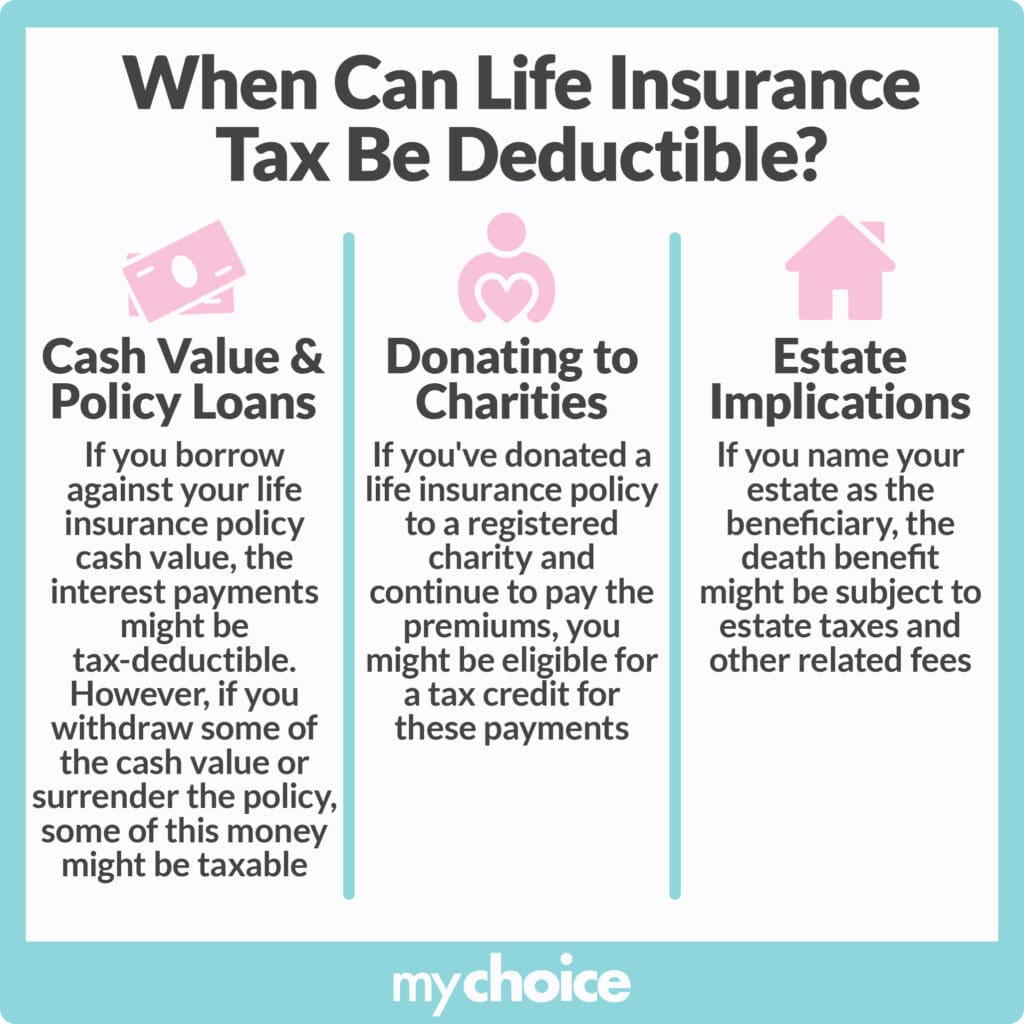
But if the payout is part of an estate (for example, the insured person owned the policy and their estate is the beneficiary), it might be subject to estate tax if the estate is large enough. Most people never reach this level, as the estate tax only applies to estates above a high threshold (over $12 million as of 2023).
Life Insurance Used For Business Loans
Sometimes, a lender requires a business owner to buy life insurance as a condition for a loan. The lender is the beneficiary to make sure the loan is repaid if the owner dies. In these cases:
- Premiums are usually not deductible as a business expense.
- If the policy is also used for other business purposes (like key person insurance), deductibility rules stay the same: If the business is the beneficiary, premiums are not deductible.
Cash Value Life Insurance And Taxes
Some life insurance policies (like whole life or universal life) build up cash value. This can make the tax rules more complicated.
- The premiums for these policies are not deductible.
- The growth of the cash value is usually tax-deferred (you don’t pay tax as it grows).
- If you withdraw money from the cash value, you might owe income tax on part of it, depending on how much you take out and how much you paid in premiums.
Example
You buy a whole life policy and pay $10,000 in premiums over several years. The cash value grows to $15,000. If you withdraw $12,000, the first $10,000 is considered a return of premium (not taxed), but the next $2,000 might be taxed as income.
Comparing Tax Treatment: Life Insurance Vs. Other Expenses
To see how life insurance payments compare to other common expenses, here’s a table:
| Expense | Tax Deductible? | Notes |
|---|---|---|
| Life insurance premiums (personal) | No | Considered a personal expense |
| Health insurance premiums (self-employed) | Yes | Subject to limits and rules |
| Mortgage interest | Yes | Itemized deduction for homeowners |
| Charitable donations | Yes | Itemized deduction if you keep records |
Common Mistakes With Life Insurance And Taxes
People often make errors when it comes to the tax treatment of life insurance. Here are two non-obvious mistakes to avoid:
- Assuming all insurance is deductible: Many people see that health insurance and mortgage interest are deductible, so they think life insurance is too. This is a common misunderstanding. The IRS treats life insurance as a personal expense.
- Double counting business deductions: Some business owners try to deduct life insurance premiums for themselves and their employees. Only premiums for group-term life (up to $50,000 per employee) are deductible, and only if the employee or their family is the beneficiary.
There’s also a little-known rule: If a business deducts premiums for a policy and later receives the death benefit, that benefit may become taxable. Businesses must pay attention to the rules to avoid surprise taxes.
Other Tax Considerations With Life Insurance
There are a few advanced situations where life insurance and taxes interact:
- Estate planning: Using life insurance in a trust (like an irrevocable life insurance trust, or ILIT) can help keep the death benefit out of your taxable estate.
- Charitable giving: Some people donate a life insurance policy to a charity. In certain cases, they may get a charitable deduction, but rules are strict. Check with a tax advisor before doing this.
- Accelerated death benefits: If a policy pays out early due to terminal illness, the payout is generally not taxed. But if you sell your policy (a life settlement), part of the proceeds may be taxable.
For more detailed IRS guidance, you can visit the official IRS Publication 525.
Frequently Asked Questions
Are Life Insurance Premiums Ever Tax Deductible For Individuals?
No, the IRS does not allow individuals to deduct premiums paid for personal life insurance. Even if you buy a policy to protect your family, it is treated as a personal expense.
Can Employers Deduct Premiums For Life Insurance They Provide To Employees?
Yes, employers can deduct premiums for group-term life insurance up to $50,000 of coverage per employee. If the company is the beneficiary, or the coverage is for an owner, premiums are not deductible.
Is The Death Benefit From A Life Insurance Policy Taxable?
In most cases, no. The death benefit paid to your beneficiaries is not considered taxable income. However, if the benefit is paid to your estate and your estate is large, it could be subject to estate taxes.
What Happens If I Withdraw Cash Value From A Life Insurance Policy?
Withdrawals up to the amount you paid in premiums are usually tax-free. Any growth (interest or earnings) withdrawn may be taxable as income. Loans against the policy are usually not taxed, but if the policy lapses, the loan could become taxable.
Are Life Insurance Premiums Tax Deductible If Required By A Divorce Agreement?
No, even if a court requires you to buy life insurance to secure alimony or child support, the premiums are not tax deductible. Only in rare cases, if structured as alimony and the recipient owns the policy, could there be a deduction.
Final Thoughts
Understanding the tax treatment of life insurance payments can help you avoid costly mistakes. For most people, premiums are not tax deductible, but there are a few exceptions for businesses and employee benefit plans. Always check with a tax professional if you are unsure, especially if your situation is unique. Remember, the main value of life insurance is protection, not tax benefits. Make sure you buy the coverage you need for the right reasons, with your eyes open to the rules.