Life insurance offers peace of mind. It helps families financially after a loved one passes away. But many people worry: Are life insurance benefits taxable income? This question is more important than it sounds. You want to know if your family receives the full payout, or if taxes will take a chunk. The answer is not always simple. It depends on how the policy is structured, who receives the money, and how the payout is handled.
This article explains how life insurance benefits interact with taxes in the United States. You’ll learn when payouts are tax-free, when they are taxable, and how to avoid common mistakes. We’ll use easy words and real examples. Whether you have a policy or plan to buy one, this guide helps you understand what to expect.

How Life Insurance Works
Life insurance is a contract between you and an insurance company. You pay regular premiums, and the company promises to pay a death benefit to your chosen beneficiary if you die. There are two main types:
- Term life insurance: Covers you for a set period (like 20 years). If you die during the term, your beneficiary gets the payout.
- Permanent life insurance: Lasts your whole life. It can build cash value over time and may have investment features.
The main goal is to provide financial protection for loved ones. Life insurance helps cover expenses like funeral costs, debts, or living costs after you’re gone.
Taxation Basics: Income Vs. Benefits
To understand if life insurance benefits are taxable, you need to know the difference between income and benefits:
- Taxable income: Money you must report on your tax return, such as wages, interest, or investment gains.
- Life insurance benefits: The payout from your policy, usually given to your beneficiary after your death.
Most people assume all money received is taxable. But the IRS treats life insurance differently.
When Are Life Insurance Benefits Tax-free?
In most cases, life insurance payouts are not taxable. Here’s why:
- The IRS considers death benefits a gift, not income. Your beneficiary does not need to report it as income.
- The money is intended to help families manage after a loss, so the government keeps it tax-free.
Example: If your policy pays $100,000 to your spouse, that $100,000 is not taxable income. They do not report it on their tax return.
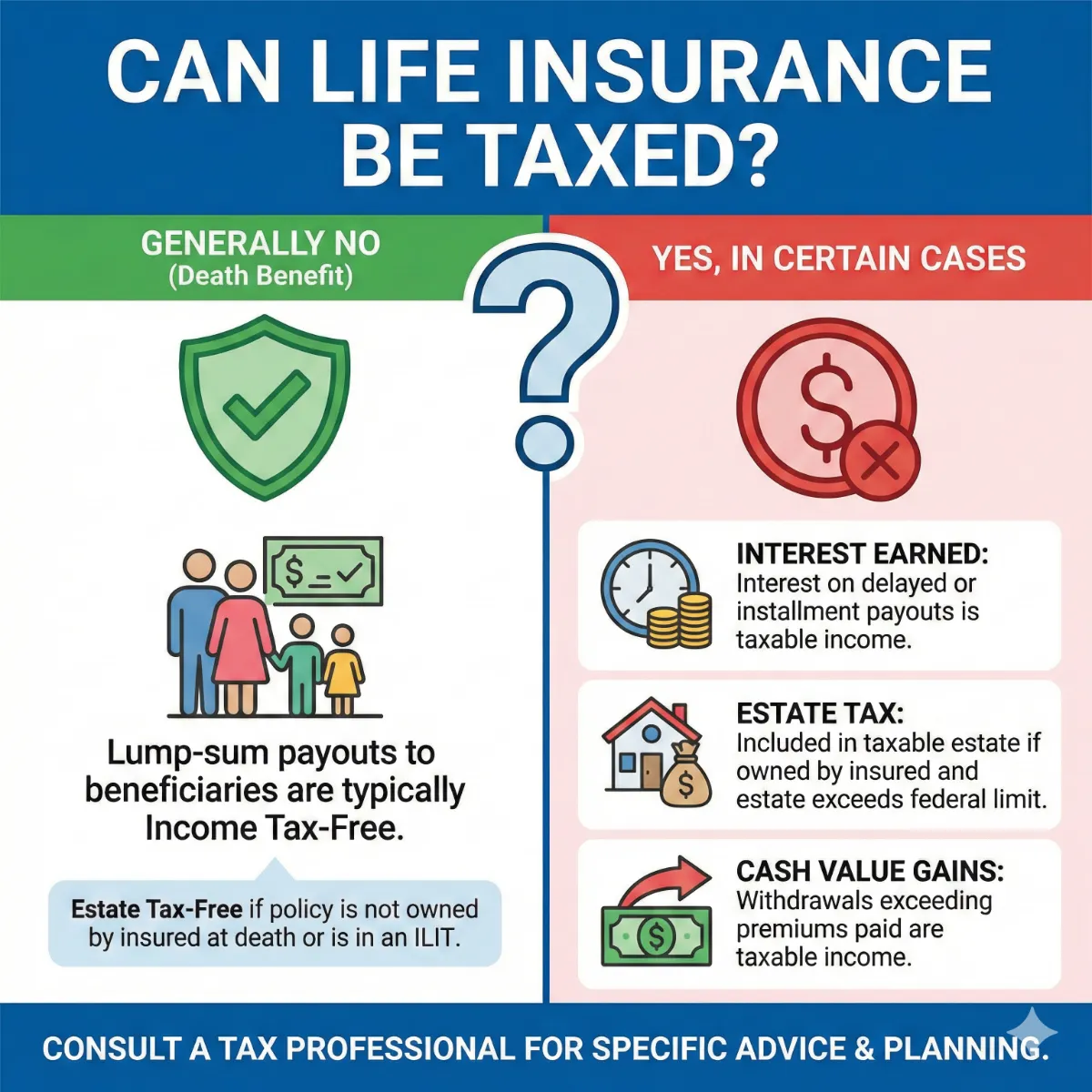
Key Insight: The tax-free rule applies only if the benefit is paid as a lump sum. If the money is paid out over time, interest may be taxable.
When Life Insurance Benefits Become Taxable
There are situations where taxes apply. Here’s when your beneficiary may owe taxes:
1. Interest Earnings
If the insurance company pays the benefit in installments (not a lump sum), the money may earn interest. The interest is taxable.
Example: Your policy pays $50,000, but your beneficiary chooses to receive $10,000 per year over five years. The insurance company adds interest to each payment. That interest is taxable as income.
| Benefit Paid | Interest Earned | Taxable? |
|---|---|---|
| $50,000 (lump sum) | $0 | No |
| $10,000/year | $500/year | Yes (interest only) |
2. Cash Value Withdrawals
Permanent life insurance policies build cash value. If you withdraw more than you paid in premiums, the excess is taxable.
Example: You paid $20,000 in premiums. Your policy’s cash value is $30,000. If you withdraw $30,000, the extra $10,000 is taxable.
3. Policy Loans
You can borrow against the cash value. Loans are usually tax-free, but if the policy lapses or is surrendered, unpaid loan amounts may become taxable.
4. Employer-paid Policies
If your employer provides life insurance, the IRS has rules:
- First $50,000 of coverage: Tax-free.
- Coverage above $50,000: The value of extra coverage is taxable as income.
Example: If your employer pays for $100,000 in coverage, the value of the extra $50,000 is taxable.
5. Estate Tax
If the death benefit goes to your estate (not directly to a person), it may be taxed as part of the estate. This applies only if the estate is very large.
2024 estate tax threshold: $12.92 million. If your estate is smaller, no estate tax applies.

Comparing Taxable And Non-taxable Situations
Understanding the difference helps you plan wisely. Here’s a comparison:
| Situation | Taxable? | Notes |
|---|---|---|
| Lump sum death benefit | No | Most common, tax-free |
| Installment payout (with interest) | Yes | Interest is taxable |
| Cash value withdrawal (excess) | Yes | Amount over premiums is taxable |
| Employer-paid coverage above $50,000 | Yes | Extra coverage is taxable |
| Estate receives benefit | Sometimes | Depends on estate size |
Common Mistakes And How To Avoid Them
Many people assume all life insurance benefits are tax-free. But mistakes can cost money. Here are common errors:
- Naming the estate as beneficiary: This can trigger estate taxes. Instead, name a person or trust.
- Not checking employer coverage limits: If your employer provides coverage, make sure you know the taxable portion.
- Ignoring cash value taxes: Withdrawals and loans can be taxable if not managed carefully.
- Forgetting to update beneficiaries: Old beneficiary designations can send the payout to the wrong person or the estate.
Tip: Review your policy every year. Make sure your beneficiary is up-to-date and you understand how payouts work.
How Life Insurance Benefits Affect Taxes For Beneficiaries
For most beneficiaries, the death benefit is not taxable income. But some situations affect taxes:
- Interest on installment payments: Must be reported as income.
- Inherited cash value: If the policyholder dies and the policy has cash value, the beneficiary may owe taxes on the gain.
Example: If you inherit a permanent life policy with $40,000 cash value, but the premiums paid were $25,000, you may owe taxes on the $15,000 gain.
Tax Implications For Policyholders
Policyholders can trigger taxes in several ways:
- Surrendering the policy: If you cancel and withdraw the cash value, any gain is taxable.
- Taking loans: If you don’t repay, and the policy lapses, the unpaid loan becomes taxable income.
- Transferring ownership: If you transfer a policy to someone else, taxes may apply if the value is greater than premiums paid.
Non-obvious insight: Some people gift their policies to avoid estate tax, but this can trigger gift tax if the policy value is high.
:max_bytes(150000):strip_icc()/do-beneficiaries-pay-taxes-life-insurance.asp-final-7e81561536514dbdb30500ba1918afb3.png)
Impact Of State Taxes
Federal taxes are not the only concern. Some states tax life insurance benefits, especially if the payout goes to the estate. State laws change often, so check your state’s rules.
Example: Florida does not tax life insurance benefits, but Pennsylvania may tax certain proceeds if they go to the estate.
Tip: Consult a local tax advisor before naming your estate as a beneficiary.
How To Minimize Tax Liability
Smart planning reduces taxes. Here are ways to keep life insurance benefits tax-free:
- Name a person or trust as beneficiary: Avoid naming your estate.
- Choose lump sum payout: If possible, select lump sum to avoid taxable interest.
- Monitor cash value withdrawals: Take out only what you paid in premiums to avoid extra taxes.
- Manage employer coverage: Keep coverage below $50,000 if possible, or be ready to report the taxable portion.
- Gift policies carefully: If gifting a policy, understand gift tax rules.
Non-obvious insight: Some trusts, like irrevocable life insurance trusts (ILITs), keep the benefit out of your estate. This can avoid estate tax for very large policies.
Real-life Examples
Let’s look at how taxes affect different life insurance payouts.
Example 1: Lump Sum Payout
Sarah’s husband dies. She receives $200,000 from his life insurance policy. She gets the full amount, tax-free.
Example 2: Installment Payout With Interest
John chooses to receive his mother’s $100,000 benefit in 10 annual payments. Each year, he gets $10,000 plus $500 interest. He must report the $500 interest as income.
Example 3: Cash Value Withdrawal
Mark’s policy has $60,000 cash value. He paid $40,000 in premiums. If he withdraws $60,000, the $20,000 gain is taxable.
Example 4: Employer-paid Coverage
Linda’s employer provides $80,000 coverage. She must report the value of $30,000 extra coverage as taxable income.
Example 5: Estate Receives Benefit
George names his estate as beneficiary. His estate is worth $15 million, above the federal threshold. The life insurance payout adds to the estate, triggering estate tax.
How Irs Views Life Insurance Benefits
The IRS has clear rules. Death benefits paid to a beneficiary are not taxable as income. But interest or gains may be taxable.
According to the IRS, “Life insurance proceeds paid by reason of the insured’s death are not taxable income and do not need to be reported. ” But if you receive interest or excess cash value, those amounts must be reported.
For more details, see the official IRS guidance at IRS Forms and Publications.
Comparing Life Insurance With Other Income Sources
It’s easy to confuse life insurance with other financial products. Here’s how it compares:
| Source | Taxable? | Notes |
|---|---|---|
| Life insurance death benefit | No | Tax-free to beneficiary |
| Interest on insurance payout | Yes | Interest is taxable |
| 401(k) withdrawal | Yes | Taxed as income |
| Inheritance (cash) | Sometimes | Depends on estate size |
| Lottery winnings | Yes | Taxed as income |
Key insight: Life insurance is one of the few financial products that delivers a tax-free payout in most cases.
Planning For Large Policies
If you have a policy worth over $1 million, estate tax could be a concern. Here’s what to do:
- Consider an irrevocable life insurance trust (ILIT) to keep the benefit out of your estate.
- Review your state’s estate tax laws.
- Talk to a tax advisor about gifting strategies.
Tip: Very few people need to worry about estate tax, but it’s important if you have large assets.
Tips For Policy Owners And Beneficiaries
Here are practical tips to avoid tax surprises:
- Read your policy carefully: Understand how payouts work.
- Update beneficiaries: Make sure the right person receives the payout.
- Choose the best payout option: Lump sum usually avoids taxes.
- Keep records: Track premiums paid, cash value growth, and any withdrawals.
- Consult a professional: Tax rules change. Get advice if your policy is large or complex.
Friendly reminder: Tax planning is easier than fixing mistakes later.
Frequently Asked Questions
Is The Life Insurance Death Benefit Taxable Income?
For most people, the death benefit is not taxable income. The IRS treats it as a gift, not income. But if the payout earns interest or is paid to your estate, taxes may apply.
What Happens If My Employer Pays For My Life Insurance?
If your employer pays for group life insurance, coverage up to $50,000 is tax-free. Any coverage above that is taxable. You must report the value of extra coverage as income.
Are Cash Value Withdrawals From Life Insurance Taxable?
If you withdraw cash value from a permanent policy, only the amount above your premiums paid is taxable. The initial premiums are not taxed.
Do I Have To Pay Taxes If I Receive Life Insurance Money In Installments?
Yes, any interest earned on installment payments is taxable. The original death benefit is tax-free, but interest must be reported as income.
Can State Taxes Affect My Life Insurance Payout?
Some states may tax life insurance proceeds, especially if they go to your estate. Most states do not tax direct payouts to a named beneficiary, but it’s best to check your local rules.
Understanding how life insurance benefits are taxed is important. With the right planning, your family can receive the full benefit without tax worries. Review your policy, update your beneficiaries, and choose the payout option that fits your needs. If your situation is complex, a tax professional can help.
Life insurance is meant to protect, and knowing the tax rules helps you keep that promise.