When you start thinking about protecting your family’s future, you’ll probably hear two terms: life insurance and accidental death insurance. On the surface, both seem to promise financial support if something happens to you. But the details, costs, and coverage can be very different. Many people confuse these two products, only to discover important differences at the worst possible time—when a claim is made.
This article will help you understand what sets life insurance apart from accidental death insurance. We’ll look at how each works, what they cover, when they pay out, and how to decide which is right for your needs. Whether you’re new to insurance or just want to make a smarter choice, this guide is designed to clear up confusion with plain language, real examples, and practical insights.

Understanding The Basics
Before diving into the details, it helps to clearly define both types of insurance.
What Is Life Insurance?
Life insurance is a contract with an insurance company. You pay regular premiums, and in return, the insurer promises to pay a lump sum (called the death benefit) to your chosen beneficiary when you die. The key is that life insurance covers death from almost any cause—illness, accident, or natural causes (with some exclusions, like suicide within the first two years, or fraud).
There are several types of life insurance:
- Term life insurance: Covers you for a set period (e.g., 10, 20, or 30 years). If you die during this time, your beneficiary gets the payout.
- Whole life insurance: Provides coverage for your entire life and builds cash value over time.
- Universal life insurance: Offers flexibility in premiums and benefits, with a savings component.
What Is Accidental Death Insurance?
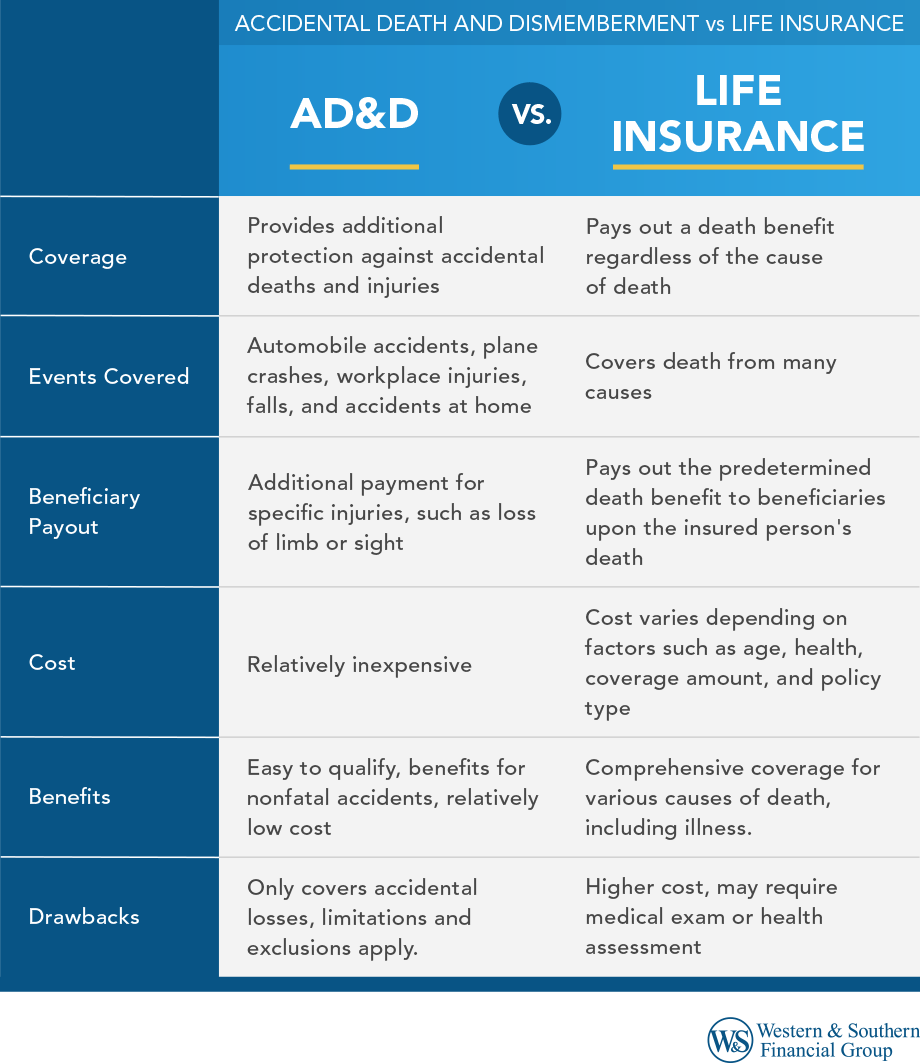
Accidental death insurance (often called Accidental Death and Dismemberment, or AD&D) only pays out if you die as a result of an accident. It does not cover death from illness, old age, or natural causes. Some AD&D policies also pay partial benefits if you lose a limb, eyesight, or other body functions due to an accident.
AD&D is usually cheaper than life insurance, but its protection is much narrower. It’s often sold as a separate policy or as a rider (add-on) to an existing life insurance policy.
Key Differences At A Glance
Sometimes, it’s easier to compare the two side by side. Here’s a quick reference:
| Feature | Life Insurance | Accidental Death Insurance (AD&D) |
|---|---|---|
| Coverage | All causes of death (except exclusions) | Accidental death only |
| Premium Cost | Usually higher | Usually lower |
| Benefit Paid For | Death | Accidental death, dismemberment |
| Policy Types | Term, whole, universal | Standalone or as a rider |
| Medical Exam Needed | Often required | Rarely required |
| Payout Examples | Illness, car accident, old age | Car accident, workplace accident |
How Each Policy Pays Out
The main difference comes down to how and when the benefit is paid.
Life Insurance Payouts
A life insurance policy pays out regardless of the cause of death, as long as you meet the policy terms. Most policies cover:
- Death from illness (like cancer or heart attack)
- Death from accidents (car crash, fall)
- Death from natural causes (old age)
Some rare exclusions include suicide (usually not covered in the first two years), death due to criminal activity, or lying on your application.
For example: If a policyholder dies from a heart attack, life insurance pays. If they die in a car accident, life insurance pays. If they die from COVID-19, life insurance pays.
Accidental Death Insurance Payouts
AD&D pays only if the death is caused by an accident, such as:
- Car crashes
- Falls
- Drowning
- Machinery accidents
It will NOT pay if the death is from illness, natural causes, suicide, or even certain risky activities that are excluded (like skydiving or war).
If the policyholder is injured in an accident (loses a limb, sight, or hearing), AD&D may pay a portion of the benefit, depending on the injury.
Example: If someone dies from cancer, AD&D does not pay. If they lose a hand in a factory accident, AD&D may pay a partial benefit.
What Counts As An “accident”?
This is a key area where many people get confused. Insurance companies define “accident” carefully, and not all sudden deaths count.
To be considered accidental, the event usually must be:
- Sudden and unexpected
- External (not from inside the body, like a heart attack)
- Not caused by illness or disease
For example, a slip and fall resulting in death is accidental. But a death from a blood clot after surgery may be excluded, since the cause was medical, not external.
A surprising fact: Many accidental death claims are denied because the death isn’t seen as “purely accidental” by the insurance company. Always check the policy’s definitions and exclusions.

Common Exclusions And Limitations
Insurance policies always have fine print. Here are some common exclusions:
Life Insurance Exclusions
- Suicide (usually not covered in the first two policy years)
- Fraud (if you lie on your application)
- Criminal acts (if you die while committing a crime)
- Act of war (less common, but possible)
Accidental Death Insurance Exclusions
- Illness or disease (heart attack, stroke, cancer)
- Drug or alcohol use (if you die while intoxicated)
- High-risk activities (like skydiving, racing)
- Suicide or self-harm
- War or military action
- Natural causes or old age
Always read the policy details. Some policies look affordable but have broad exclusions.
Who Should Consider Each Type?
Choosing between life insurance and accidental death insurance depends on your needs, health, and budget.
When Life Insurance Makes Sense
- You have dependents who rely on your income
- You want to cover final expenses, debts, or a mortgage
- You want to leave a legacy or help with your children’s education
- You’re worried about death from any cause, not just accidents
Life insurance is usually the foundation of financial protection for families. It’s more expensive, but much more likely to pay out.
When Accidental Death Insurance Can Be Useful
- You work in a risky job (factory, construction, driving)
- You can’t qualify for regular life insurance (poor health, high premiums)
- You want extra coverage for accidents (as a supplement, not a replacement)
- Your budget is very limited
AD&D is often used to add extra protection, not as the only coverage. On its own, it’s not enough for most families.
Real-life Examples
Stories make things clearer. Here are two scenarios:
Case 1: Maria’s Family
Maria, 38, is a mother of two and works as a nurse. She buys a $500,000 term life insurance policy. Sadly, she is diagnosed with cancer and passes away three years later. Her policy pays the full benefit to her family, helping with expenses and her children’s future.
If Maria only had accidental death insurance, her family would get nothing—cancer is not an accident.
Case 2: John’s Accident
John, 42, is a delivery driver. He has both life insurance and an AD&D rider. He dies in a car crash. His family receives the life insurance benefit, and the AD&D policy pays an additional amount because his death was an accident.
This extra money helps cover immediate expenses and debts.
Cost Differences
You might wonder: why is accidental death insurance so much cheaper than life insurance? The answer is simple: it’s much less likely to pay out.
Statistics show that:
- The majority of deaths (about 80-90%) are due to illness or natural causes, not accidents.
- Only about 5-10% of deaths in adults aged 25–64 are due to accidents.
Because accidental death is less common, insurers can offer lower premiums. But that also means the policy is far less likely to help your family when they need it.
Here’s a rough price comparison for a healthy 35-year-old (male, non-smoker):
| Policy Type | Coverage Amount | Monthly Cost |
|---|---|---|
| Term Life Insurance | $250,000 | $20–$30 |
| Accidental Death Insurance | $250,000 | $8–$15 |
*Prices can vary based on age, health, and company. Always compare quotes. *
Medical Exams And Application Process
One barrier to buying life insurance is the medical exam. Let’s compare:
Life Insurance
- Most term and whole life policies require a medical exam (blood test, health questions).
- If you’re young and healthy, the process is fast and affordable.
- Pre-existing conditions can increase your premium or result in denial.
Accidental Death Insurance
- Usually no medical exam is needed.
- Most people are accepted, regardless of health.
- Application is quick—sometimes approved the same day.
This makes AD&D appealing for people who can’t qualify for regular life insurance. But remember, the coverage is much more limited.
Riders And Bundled Coverage
Sometimes, you don’t have to choose between these options—you can combine them.
Life Insurance With An Ad&d Rider
Many life insurance policies offer an accidental death rider for a small extra cost. If you die from an accident, your beneficiary gets both the life insurance amount and the AD&D benefit.
Example: If your life insurance is $200,000, and you add a $100,000 AD&D rider, your family would get $300,000 if you die in a covered accident.
Standalone Accidental Death Insurance
You can buy AD&D as a separate policy, especially through work or associations. Some credit cards and banks offer accidental death coverage as a perk, but these are usually small amounts ($10,000–$20,000).

Pros And Cons
Let’s look at the advantages and disadvantages of each:
| Life Insurance | Accidental Death Insurance | |
|---|---|---|
| Pros |
|
|
| Cons |
|
|
Insights Most People Miss
When comparing these products, beginners often overlook a few important points:
- Statistical likelihood: Most deaths are not accidental, so AD&D alone rarely pays out. Life insurance is more likely to help your family.
- Stacking benefits: If you have both, your family can receive both payouts if the death is accidental. Many people don’t realize you can combine coverage.
- Partial payouts: AD&D may pay if you’re seriously injured (lose a limb, vision, etc. ), even if you survive. Life insurance does not.
- Workplace coverage isn’t enough: Many employers offer group life or AD&D, but these are often small ($10,000–$50,000) and may end when you leave your job. Always check if it’s portable.
How To Choose The Right Policy For You
Here’s a practical approach for making your decision:
- Assess your needs: Who depends on you financially? How much would they need if you were gone?
- Review your health: If you’re healthy, term life insurance is affordable and broad. If not, consider guaranteed-issue or accidental death.
- Check your budget: If money is tight, some coverage is better than none. But know what you’re really getting.
- Read the fine print: Always check what’s covered and excluded. Don’t assume.
- Ask about riders: Adding AD&D to life insurance is often cheap and increases your total protection.
- Don’t rely on work coverage alone: Get your own policy if possible.
A tip: Use online calculators or talk to a trusted agent to estimate how much coverage you need. Don’t just guess.
Real-world Data And Trends
According to the National Safety Council, accidental deaths accounted for only about 6% of all deaths in the United States in 2020. The most common causes were unintentional poisoning, car crashes, and falls.
Life insurance claims, on the other hand, are paid out far more often, since they cover most causes of death. In 2022, U. S. life insurers paid out over $100 billion in death benefits, according to the American Council of Life Insurers.
This shows that while accidental death coverage is popular for its low cost, life insurance offers far more comprehensive protection.
How Claims Are Handled
The claims process is similar for both types, but there are a few differences.
Life Insurance Claims
- Beneficiary submits a claim and death certificate.
- Insurer reviews for exclusions or fraud.
- Payout is typically made within 30–60 days.
Accidental Death Claims
- Beneficiary must provide proof the death was accidental (police report, medical records).
- Insurer investigates to confirm cause.
- Disputes are more common, and payouts can take longer if there is any doubt.
If you have both policies, you may need to file two separate claims.
Making A Smart Decision
Choosing insurance isn’t just about price—it’s about peace of mind. Most families are best protected by life insurance, possibly with an accidental death rider for extra security. Standalone AD&D is rarely enough, except in special cases.
Always consider your own situation, not just what’s cheapest. The right coverage can make all the difference if the unexpected happens.
For more in-depth analysis on insurance products, you can visit the Insurance Information Institute.
Frequently Asked Questions
What Is The Main Difference Between Life Insurance And Accidental Death Insurance?
Life insurance pays out for death from any cause (except specific exclusions), including illness and accidents. Accidental death insurance only pays if death is caused by a covered accident. This is the biggest difference—AD&D does not cover illness or natural causes.
Can I Have Both Life Insurance And Accidental Death Insurance?
Yes, you can. Many people add an accidental death rider to their life insurance or buy both separately. If you die in an accident, your beneficiaries may receive both payouts.
Does Accidental Death Insurance Cover Injuries?
Yes, many AD&D policies pay partial benefits if you lose a limb, eyesight, hearing, or speech due to an accident. This is called the “dismemberment” benefit. Life insurance only pays for death, not injury.
Do I Need A Medical Exam For Accidental Death Insurance?
Usually, no. Most AD&D policies do not require a medical exam or health questions. This makes them easier to get, but remember that coverage is limited to accidents only.
Is Workplace Accidental Death Insurance Enough?
Probably not. Employer-provided AD&D is often a small amount and may end if you leave your job. It’s a nice benefit, but most people need extra, personal coverage to fully protect their families.
Understanding the difference between life insurance and accidental death insurance can protect your loved ones from unexpected financial hardship. Take time to review your needs, ask questions, and read the details before choosing. The right insurance gives you—and your family—confidence for the future.