
Choosing between whole life insurance and Indexed Universal Life insurance (IUL) is a major decision for anyone planning long-term financial security. Both products offer lifelong coverage, cash value growth, and flexibility beyond standard term insurance. But the details—and the differences—can have a big impact on your financial future. Understanding how these two types work, what they cost, and who they’re right for can help you make a smart choice that fits your goals, needs, and budget.
What Is Whole Life Insurance?
Whole life insurance is a type of permanent insurance. It offers coverage for your entire life, as long as you pay the premiums. When you pass away, your beneficiaries receive a guaranteed death benefit. But whole life also has a cash value component, which grows at a fixed rate set by the insurer.

Premiums are usually fixed and predictable. A portion of each payment goes toward building the cash value, which you can borrow against or even withdraw (with some restrictions). The growth is slow but steady, often compared to a conservative savings account.
Some people use whole life insurance for estate planning, leaving a financial legacy, or as a forced-savings tool. However, the cost is usually higher than term life policies for the same death benefit.
What Is Indexed Universal Life (iul) Insurance?
Indexed Universal Life insurance is also permanent, but it works differently. IULs have flexible premiums and death benefits. Their cash value can grow based on the performance of a stock market index, such as the S&P 500, rather than a fixed interest rate.
This means your cash value can potentially grow faster than with whole life, but there’s also more risk. Most IULs protect you from market losses with a floor (often 0%), but limit how much you can gain with a cap (for example, 10-12%).
You can adjust how much you pay each year (within limits) and even change the death benefit amount. This flexibility is attractive to people who want to manage their policy over time. But understanding the fees, caps, and participation rates is essential, as these can reduce your returns.
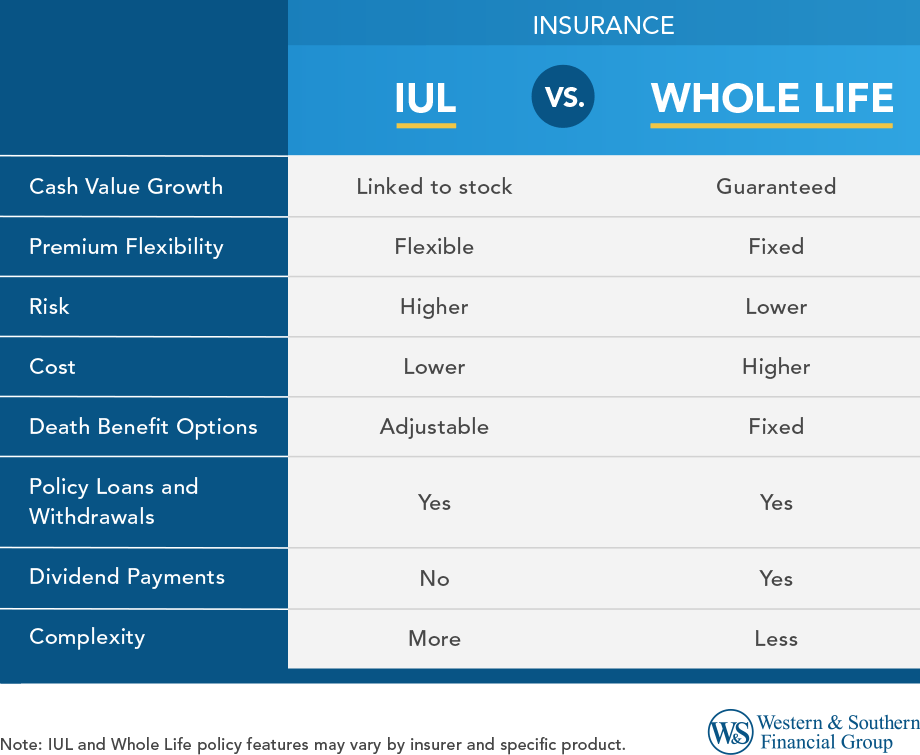
Key Differences: Whole Life Vs Iul
To make things clearer, here’s a direct comparison of the main features:
| Feature | Whole Life Insurance | Indexed Universal Life (IUL) |
|---|---|---|
| Premiums | Fixed, predictable | Flexible, can change |
| Death Benefit | Guaranteed, fixed | Adjustable, flexible |
| Cash Value Growth | Fixed interest (set by insurer) | Linked to market index (with caps/floors) |
| Risk | Low, stable returns | Moderate, tied to index |
| Policy Loans | Available, with interest | Available, with interest |
| Cost | Usually higher | Varies, often lower at first |
Pros And Cons Of Whole Life Insurance
Advantages
- Guaranteed Death Benefit: Your loved ones will receive a payout no matter when you die.
- Predictable Premiums: You always know what you’ll pay, making budgeting easier.
- Stable Cash Value Growth: The insurer sets a minimum rate, so your cash value is steady.
- Dividends: Some whole life policies pay dividends, which can be used to reduce premiums, increase coverage, or grow cash value even more.
Drawbacks
- High Premiums: Whole life can be expensive—sometimes 5 to 15 times the cost of term life for the same coverage.
- Slow Cash Value Growth: It may take years before the cash value becomes significant.
- Less Flexibility: You can’t easily change your premiums or death benefit.
Pros And Cons Of Iul Insurance
Advantages
- Potential for Higher Returns: Cash value grows based on stock market index performance, possibly beating whole life over time.
- Premium Flexibility: You can pay more or less each year, as long as the policy stays funded.
- Adjustable Death Benefit: You may increase or decrease the payout amount as your needs change.
- Downside Protection: Even if the market drops, your cash value usually won’t decrease below zero due to the floor.
Drawbacks
- Complexity: IULs involve moving parts—caps, floors, participation rates—that can be confusing for beginners.
- Costs and Fees: Charges for administration, insurance, and features can eat into your gains.
- No Guaranteed Cash Value Growth: Returns depend on market performance and insurer rules.
How Do Costs Compare?
Cost is often the biggest factor when choosing between whole life and IUL. Here’s a side-by-side look at typical costs for a healthy 35-year-old buying a $500,000 policy:
| Policy Type | Monthly Premium (Approx.) | Guaranteed Cash Value at Year 10 |
|---|---|---|
| Whole Life | $300–$400 | $30,000–$35,000 |
| IUL | $200–$350 | $25,000–$45,000 (not guaranteed) |
These numbers are estimates and can vary depending on the insurer, health rating, and specific policy features. Notice that IUL premiums may start lower, but the range of possible cash value is wider—because it depends on how the index performs.
Cash Value: How Does It Really Grow?
A common beginner mistake is assuming the cash value in either policy will always grow quickly. In reality:
- With whole life, cash value grows slowly at first, then picks up speed after several years.
- With IUL, growth can jump in good years or stay flat if the market performs poorly.
- Both types have policy fees and insurance charges that reduce actual growth.
Another detail many miss: If you borrow from your cash value, unpaid loans plus interest reduce your death benefit.
Who Should Choose Whole Life Insurance?
Whole life is best for people who:
- Want certainty: If you value guaranteed cash value and a fixed death benefit, whole life delivers.
- Have a stable budget: High, fixed premiums mean you need steady income.
- Prefer simplicity: The policy is easy to understand and manage.
- Plan for estate needs: Whole life is popular for passing wealth to heirs or covering estate taxes.
Tip: If you have a long-term view and want to leave money for family or charity, whole life is a strong choice. But be prepared for higher costs.
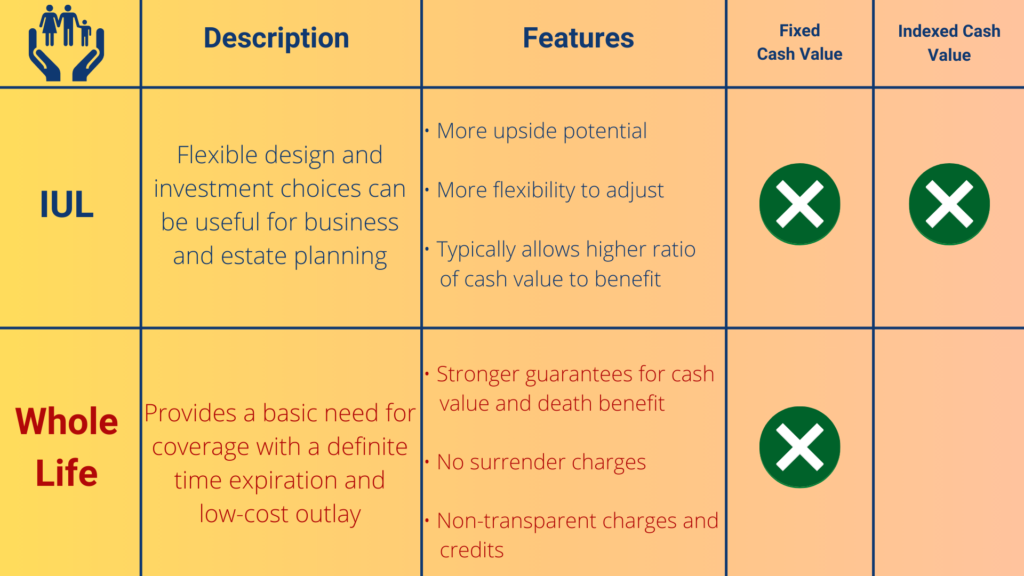
Who Should Consider Iul Insurance?
IUL is often better for people who:
- Want potential for higher returns: If you’re comfortable with some risk, IUL offers upside based on market indexes.
- Need flexibility: You can change your premium payments or death benefit as your life changes.
- Have irregular income: Self-employed or commission-based earners can adjust payments.
- Are interested in cash value for supplemental retirement income: With smart management, IULs can provide tax-advantaged loans in retirement.
Warning: IULs are complex. If you don’t actively manage your policy or understand the details, you could lose value. Always ask your agent to explain the participation rate, cap, floor, and all fees.
Practical Examples
Example 1: Jane Chooses Whole Life
Jane, 40, wants to leave $250,000 for her children and dislikes risk. She chooses a whole life policy with a $400 monthly premium. Her cash value grows at 4% annually (guaranteed by the insurer). After 20 years, she has built up over $100,000 in cash value, and her death benefit is secure.
Example 2: Mike Picks Iul
Mike, 35, wants both protection and investment growth. He buys an IUL with a $300 monthly premium. His cash value tracks the S&P 500 with a 10% cap and 0% floor. In good market years, his account grows faster than Jane’s, but in flat years it grows little.
Mike can skip a payment during a slow business month, but must monitor costs and market trends.
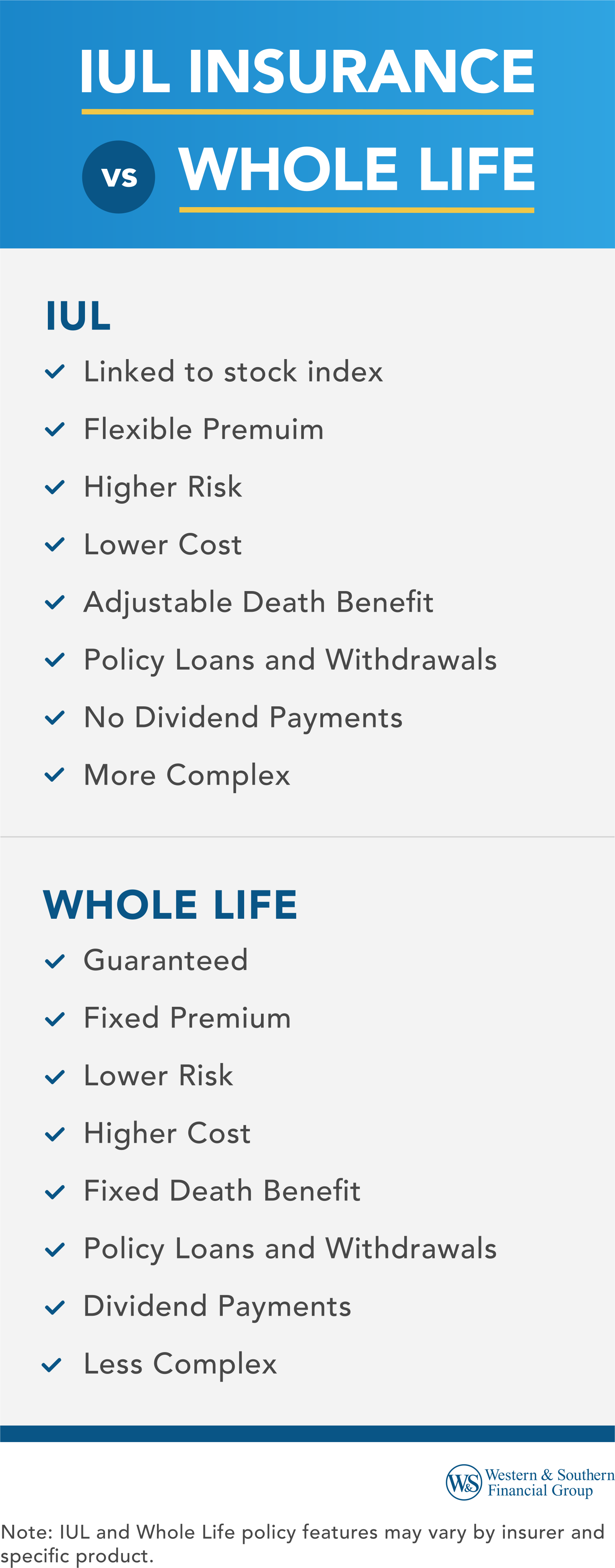
Common Mistakes To Avoid
- Ignoring the fine print: Always read how caps, floors, and fees work in IULs.
- Overestimating returns: Don’t expect stock market returns in IULs—caps limit growth.
- Neglecting policy funding: Skipping too many payments (even if allowed) can cause an IUL to lapse.
- Borrowing too much: Policy loans reduce your death benefit if not repaid.
Can You Switch Between Whole Life And Iul?
You usually can’t switch policies directly, but you can use a 1035 exchange to move the cash value from one permanent life policy to another without tax penalties. This is useful if your needs change, but always check fees and surrender charges before making a move.
Real-world Data And Trends
According to the American Council of Life Insurers, whole life makes up about 36% of all individual life insurance in the US, while universal life (including IUL) accounts for about 40%. IUL sales have grown rapidly in the last decade because of interest in market-linked growth and flexibility.
A recent industry report found that many policyholders do not fully understand their IUL policy’s moving parts, leading to disappointment with cash value growth. Education and regular policy reviews are essential for success with either option.
For more background on insurance types, see this Wikipedia article.
Final Thoughts: Which Is Better?
There’s no one-size-fits-all answer. Whole life insurance is better for people who want guarantees, steady growth, and simplicity—even if it costs more. IUL is better for those who want flexibility, can handle a bit more risk, and are interested in potentially higher returns—if they pay attention to policy details.
The right choice depends on your budget, risk tolerance, and long-term goals. If in doubt, talk to a qualified financial advisor who can explain how each fits with your financial plan.
Frequently Asked Questions
What Happens If I Stop Paying Premiums On My Whole Life Or Iul Policy?
If you stop paying premiums, your policy could lapse. Whole life policies may use cash value to pay premiums for a while. IULs may allow flexible payments, but if the cash value runs out, coverage ends.
Can I Lose Money In An Iul Policy?
You can’t lose cash value due to market drops because of the floor (often 0%), but fees and poor performance can cause your account to grow slowly or even shrink after charges.
Are Policy Loans From Whole Life Or Iul Taxable?
Policy loans are not taxable as long as your policy stays in force. If the policy lapses with an outstanding loan, the remaining balance may become taxable.
Can I Use Whole Life Or Iul For Retirement Income?
Yes, both allow you to borrow or withdraw cash value during retirement. Many use IUL for this because of its potential for higher growth, but both types can supplement retirement income.
How Do I Compare Policies From Different Companies?
Look at premiums, death benefit guarantees, cash value growth projections, fees, and insurer financial strength. Always ask for a detailed policy illustration and review it with a trusted advisor.