
Many people think life insurance only helps after someone dies. But did you know you can use life insurance while you are still alive? Life insurance can be more than just a safety net for your family after you’re gone.
It can also be a smart tool for your own needs, plans, and even emergencies while you’re living. If you understand how it works, you can make your policy work for you now—not just later.

This article will explain the different ways to use life insurance during your lifetime. You’ll see real examples, learn about the main options, and discover things that many people miss. Whether you already have a policy or are thinking about getting one, these tips can help you get the most value from your coverage.
Understanding Living Benefits
Most people buy life insurance for peace of mind. They want to know their loved ones will be okay if something happens to them. But many types of life insurance offer living benefits, too. These are features that let you use part of your policy’s value while you’re still alive.
Not all policies are the same. The two main types are term life insurance and permanent life insurance. Term life usually covers you for a set period, like 20 or 30 years, but often does not have living benefits. Permanent life insurance, such as whole life or universal life, lasts your whole life and builds cash value over time. This cash value is what you can use while you’re alive.
How Cash Value Works
When you pay your premium for permanent life insurance, part of the money goes into a savings-like account called cash value. This account grows slowly, often with interest or investment gains. Over time, you can access this money for different needs.
Example: If you start a whole life policy at age 30 and pay for 20 years, you might have built up $20,000 or more in cash value by age 50, depending on the policy and payments.
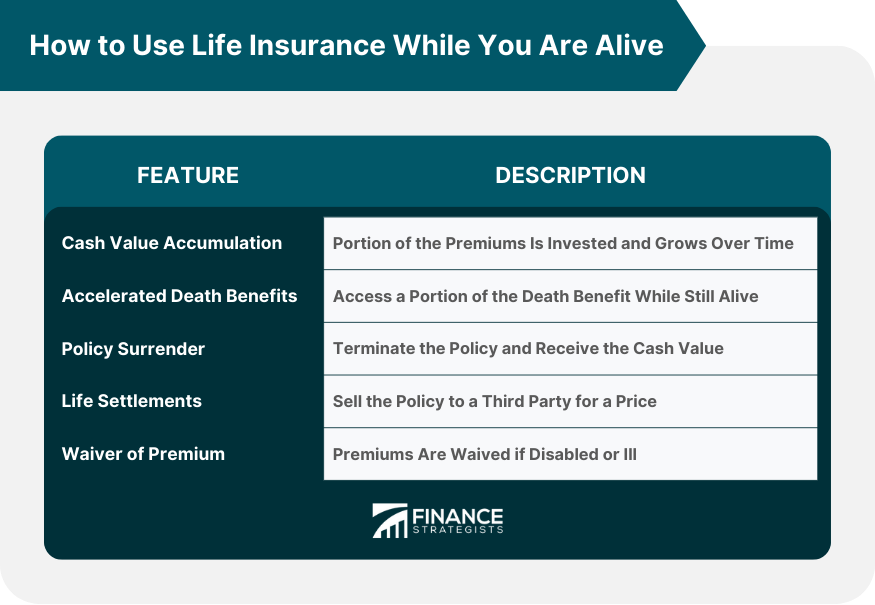
Ways To Use Life Insurance While Alive
Let’s look at the most common ways people use their policies while they’re living. Each method has its own benefits and risks.
1. Cash Value Withdrawals
If you have a permanent policy, you can withdraw cash value. This means taking out some of the money you’ve built up in your policy.
- You can use this money for anything: College bills, home repairs, or emergencies.
- Withdrawals are usually tax-free up to the amount you’ve paid in premiums.
- Taking out cash reduces your policy’s death benefit (the amount your family gets if you die).
Tip: Only withdraw what you need. Large withdrawals can leave your policy with little value for your family later.
2. Policy Loans
You can borrow money from your policy’s cash value. This is called a policy loan.
- You pay interest on the loan, but rates are often lower than credit cards or bank loans.
- No credit check is needed; you just request the loan from your insurer.
- If you don’t pay the loan back, the unpaid amount is taken out of your death benefit.
Example: If your policy has $30,000 in cash value, you might be able to borrow up to $25,000. If you pass away with $10,000 unpaid, that amount is subtracted from what your family gets.
Non-obvious insight: Loans don’t have fixed repayment schedules. You decide when and how much to pay back, but unpaid loans keep growing with interest.
3. Living Benefits Or Accelerated Death Benefits
Some policies let you access part of your death benefit early if you get very sick. This is called an accelerated death benefit or living benefit rider.
- If you’re diagnosed with a terminal illness (often with less than 12–24 months to live), you can get a portion of your policy’s payout early.
- The money is usually tax-free and can be used for medical bills, care, or anything you want.
Table: Common Living Benefit Triggers
| Trigger | Available Benefit | Typical Uses |
|---|---|---|
| Terminal illness | Up to 80% of death benefit | Medical care, family support |
| Chronic illness | Varies by policy | Long-term care, home help |
| Critical illness | Varies by policy | Major surgeries, recovery expenses |
Non-obvious insight: You must request these benefits and provide medical proof. Not all policies include them, so ask your agent or check your policy details.
4. Surrendering The Policy
You can surrender your permanent policy and get the cash value. This means you cancel the policy and take the money.
- You receive the remaining cash value, minus any surrender fees (which can be high in the first years).
- You lose your life insurance coverage.
People sometimes do this if they no longer need coverage or want the money for a big expense, like buying a house or paying off debt.
Practical tip: Surrendering is usually best as a last resort. You might lose more in fees and taxes than you expect.
5. Using Dividends
Some whole life policies pay dividends. These are a share of the insurer’s profits.
- You can take dividends as cash, use them to pay premiums, or add them to your cash value.
- Dividends are not guaranteed every year.
Example: If your policy pays a $500 dividend, you could use it to reduce your yearly payment or take it as extra spending money.

Credit: www.annuityexpertadvice.com
Comparing Ways To Access Your Policy’s Value
Here’s a quick look at how the main options compare:
| Method | Money Kept in Policy? | Tax Impact | Death Benefit Reduced? |
|---|---|---|---|
| Withdrawal | No | Usually tax-free up to premiums paid | Yes |
| Loan | Yes | Not taxed if managed properly | Yes, if not repaid |
| Accelerated Benefit | No | Usually tax-free | Yes |
| Surrender | No | Taxed on gains | Policy ends |
Important Things To Know Before Using Your Policy
It’s smart to understand the rules and risks before you use your policy’s value.
Watch For Surrender Charges And Fees
Permanent life insurance often has surrender charges if you cancel or take out money in the first years. These fees can take away a big part of your cash value.
Example: If your cash value is $10,000 and the surrender fee is $2,500, you only get $7,500.
Tax Surprises
Not all cash value use is tax-free. If you withdraw more than you paid in premiums, you might owe taxes on the gain. Loans are usually tax-free, but if the policy lapses (ends), you could owe taxes on the unpaid loan.
Tip: Talk to a tax pro before taking large withdrawals or loans.
Policy Lapse Risk
Using too much of your cash value can make your policy lapse. This means it ends and you lose coverage, sometimes with big tax bills.
Non-obvious insight: If your loan and interest grow bigger than your cash value, your policy can end without warning.
Impact On Family
Every time you take money from your policy, your death benefit goes down. This means your family gets less if you pass away.
Practical example: If your policy was for $200,000 and you take a $50,000 loan you don’t pay back, your family will get $150,000 instead.
Special Uses Of Life Insurance While Alive
Some creative ways people use life insurance include:
- Paying for college: Cash value can help with school costs.
- Starting a business: Borrow from your policy to fund a new idea.
- Emergency fund: Fast access to cash for sudden expenses.
- Supplementing retirement: Take loans or withdrawals to boost income in later years.
Note: These ideas work best if you plan carefully and don’t take out too much.
Who Should Consider Using Life Insurance This Way?
Not everyone will benefit from using their life insurance while alive. These options make sense if you:
- Have a permanent policy with enough cash value built up.
- Need access to money and want flexible options.
- Are comfortable with a smaller death benefit for your family.
If you only have a term policy, you usually won’t have cash value to use. But you might have living benefits if your policy has special riders.

Credit: www.nationwide.com
Common Mistakes To Avoid
- Taking out too much cash value too soon. Your policy may collapse or lose its tax benefits.
- Forgetting about interest on loans. Unpaid interest can grow fast, shrinking your benefit.
- Not checking fees and taxes before withdrawing or surrendering.
- Ignoring policy riders. Some people don’t know their policy includes living benefits for illness or injury.
- Missing paperwork requirements. Insurers need forms and proof before you can use living benefits.
When To Get Help
Before using your life insurance’s value, it’s wise to talk with:
- Your insurance agent: They know your policy’s details.
- A tax advisor: They can explain tax effects.
- A financial planner: They can help you choose the best method.
Tip: Ask for a policy statement that shows your current cash value, loans, and possible fees.
For more details on how life insurance works, you can read more at Investopedia.
Credit: www.financestrategists.com
Frequently Asked Questions
What Types Of Life Insurance Let You Use Money While Alive?
Only permanent life insurance (like whole or universal life) builds cash value you can use while living. Most term life insurance does not have this feature, though some term policies have living benefit riders for illness.
Are Policy Loans Tax-free?
Yes, policy loans are usually tax-free as long as your policy stays active. But if the policy lapses with a loan outstanding, you might owe taxes on the loan amount.
Can I Use Life Insurance To Pay For Retirement?
Yes, you can use cash value withdrawals or loans from your policy to supplement retirement income. But this will lower the death benefit for your family, so plan carefully.
What Happens If I Don’t Pay Back A Policy Loan?
If you don’t repay a policy loan, the unpaid balance (plus interest) is subtracted from your death benefit. If the loan gets too big, your policy could lapse.
How Soon Can I Access My Cash Value?
It usually takes several years (often 5–10) to build enough cash value to use. The first years of your policy mostly go to fees and costs, so cash value grows slowly at first.
Life insurance can do much more than protect your family after you’re gone. With the right policy and good planning, you can use it as a flexible tool while you’re alive. Whether you need money for an emergency, want to fund a big goal, or need help during an illness, understanding your options helps you make the best choices.
If you’re thinking about using your policy’s living benefits, review your policy details and talk to experts before making big decisions. This way, you’ll get the most from your life insurance—both now and later.