
Life insurance and life assurance sound almost the same. Many people think they are just two names for one thing. But these terms are different, especially in the UK and some other countries. Understanding the difference can help you choose the right protection for your family, your finances, and your peace of mind.
If you are confused about what makes life insurance and life assurance different, or which one fits your needs, this guide will help you see things clearly.

What Is Life Insurance?
Life insurance is a contract between you and an insurance company. You pay regular payments, called premiums, and the company promises to pay money to your family or another person if you die during the time covered by the policy. This time is often called the policy term. If you do not die during this term, the policy usually ends, and you do not get any money back.
Life insurance is very common in the United States and many other countries. It is often used to:
- Protect your family from financial problems if you die
- Cover debts like a mortgage
- Pay for children’s education
- Help with funeral costs
There are two main types of life insurance:
1. Term Life Insurance
This covers you for a set number of years, such as 10, 20, or 30 years. If you die during this period, your family gets the payout. If you survive past the term, the policy ends, and you get nothing.
2. Whole Life Insurance
This covers you for your entire life, as long as you keep paying premiums. It is less common in the UK, but popular in the US. Whole life insurance also builds up some savings called cash value.
But in the UK and some other places, the term “life insurance” usually means term life insurance.
What Is Life Assurance?
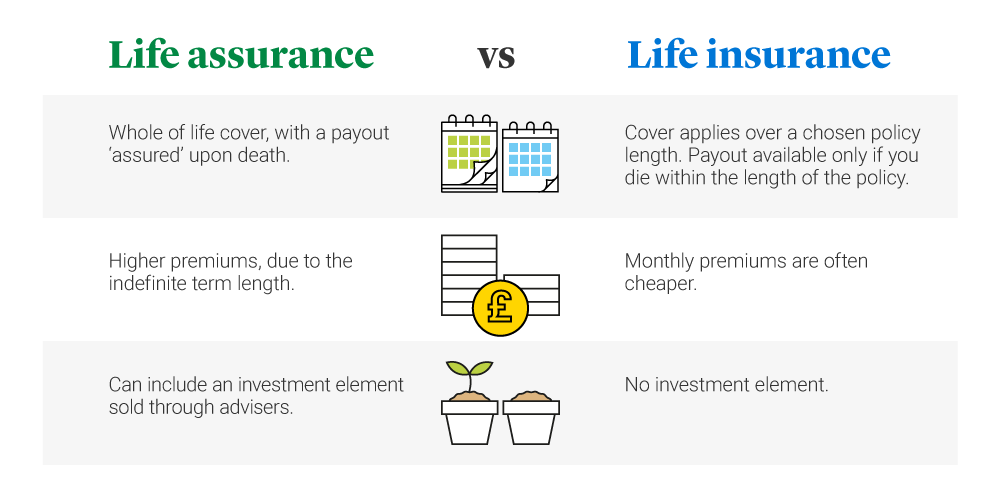
Life assurance is sometimes called whole-of-life insurance. Unlike life insurance, life assurance is meant to last your entire life. As long as you pay the premiums, the insurance company will pay out a sum of money when you die—no matter when that happens.
Life assurance is often used for:
- Leaving money for your family
- Estate planning
- Paying inheritance taxes
- Creating a legacy
Because life assurance guarantees a payout, it is usually more expensive than term life insurance. Life assurance policies may also build up a cash value, which you can borrow against or withdraw.
Key Differences Between Life Insurance And Life Assurance
The main difference is in the length of coverage and the guarantee of payout. Here are the most important differences:
- Coverage Duration
- Life insurance covers you for a set period (term).
- Life assurance covers you for your whole life.
- Payout Guarantee
- Life insurance pays out only if you die during the term.
- Life assurance pays out whenever you die.
- Cost
- Life insurance is usually cheaper, because most people outlive their policy term.
- Life assurance is more expensive, since the company always has to pay out.
- Savings or Investment Element
- Life insurance usually has no savings part.
- Life assurance may build up cash value over time.
- Purpose
- Life insurance is for short-term needs, like covering a mortgage or raising kids.
- Life assurance is for long-term planning, like leaving money to your heirs.
- Policy Expiry
- Life insurance expires at the end of the term.
- Life assurance does not expire until you die.
Here is a quick comparison:
| Feature | Life Insurance | Life Assurance |
|---|---|---|
| Coverage | Fixed term (10-30 years) | Whole life |
| Payout | Only if death occurs during term | Guaranteed on death |
| Cost | Lower premiums | Higher premiums |
| Cash Value | No (usually) | Yes |
| Purpose | Short-term financial protection | Long-term estate planning |
| Expiry | Ends after term | Never expires |
How Do Premiums Work?
Premiums are the payments you make for your policy. Both types require you to pay premiums, but the way they are set can be different.
- Life insurance premiums are usually fixed for the length of the term. You pay the same amount every month or year.
- Life assurance premiums can be higher, but they may also build up cash value. Some policies allow you to pay for a certain number of years, then stop paying, but still keep coverage.
Some policies may also offer level premiums (same throughout) or increasing premiums (rise over time, usually to cover inflation).
Let’s compare premium examples:
| Policy Type | Typical Monthly Premium (Age 35, $250,000 coverage) | Guaranteed Payout? |
|---|---|---|
| Term Life Insurance | $20–$30 | No |
| Whole Life Assurance | $120–$150 | Yes |
These numbers are just examples. Your premium depends on your age, health, coverage amount, and policy type.

What Happens When The Policy Ends?
For term life insurance, if you survive past the term (for example, 20 years), the policy ends. You do not get any money back. Some companies offer return-of-premium term policies, but these are rare and expensive.
For life assurance, the policy only ends when you die. Your family gets the payout no matter how long you live.
Why Do The Terms Matter?
In the US, most people use “life insurance” for both term and whole life policies. In the UK, the difference between “insurance” and “assurance” is more strict. Knowing the terms helps you ask the right questions and choose the best policy.
If you ask for life insurance in the UK, you will likely get a term policy. If you want a guaranteed payout, you should ask for life assurance.
Pros And Cons: Life Insurance Vs. Life Assurance
Every type has benefits and drawbacks. Here’s a look at both sides:
Life Insurance Pros
- Lower cost for most people
- Good for temporary needs (mortgage, kids)
- Simple to understand
Life Insurance Cons
- No payout if you survive the term
- No savings or investment part
- May need to buy new policy as you get older
Life Assurance Pros
- Guaranteed payout for your family
- Helps with estate planning and inheritance tax
- May build up cash value
Life Assurance Cons
- Higher premiums
- More complex contracts
- May not be needed for everyone
Choosing The Right Policy For Your Needs
Picking between life insurance and life assurance depends on your goals and your budget. Here are some questions to ask yourself:
- Do you need protection for a set time or for your whole life?
If you want to cover a mortgage or raise children until they are grown, term life insurance may be enough.
- Do you want to leave a legacy or cover estate taxes?
Life assurance is better for long-term planning and guaranteed payouts.
3. Can You Afford Higher Premiums?
Life assurance costs more, but it offers more security.
4. Do You Want A Savings Or Investment Part?
Life assurance often includes cash value, while term life insurance does not.
5. Are You Worried About Outliving Your Policy?
Life assurance removes this risk.
Many people combine both types. For example, you could buy term life insurance for your mortgage and life assurance for your estate.
Real-life Examples
Let’s look at two situations:
- Sarah, age 40, mother of two, has a $200,000 mortgage. She buys a 20-year term life insurance policy. If she dies before the mortgage is paid off, her family gets the payout. If she survives, the policy ends, but the mortgage is gone.
- Michael, age 50, has a large estate and wants to leave money to his children. He buys a life assurance policy. No matter when he dies, his heirs get the payout, which helps pay inheritance tax.
These examples show how the two types serve different needs.
Common Misunderstandings
Many people think life assurance is just a fancy name for life insurance. But understanding the differences saves you from costly mistakes.
A non-obvious insight: Life assurance policies may have surrender values. If you cancel early, you may get some money back. Term life insurance rarely offers this.
Another insight: Some life assurance policies include investment options. These can be risky, and returns are not always guaranteed. Always check if your policy is “with profits” or “unit-linked.”
How Insurers Assess Risk
Insurance companies look at your age, health, lifestyle, and family history. Smokers pay higher premiums. Some companies require a medical exam.
For life assurance, the company knows they will pay out someday, so premiums are higher. For term life insurance, the risk is only during the term. If you live longer, the company keeps your premiums.
Statistics And Data
According to the Life Insurance Market Report (2023):
- Around 60% of UK households have some form of life insurance.
- Only about 10% have whole-of-life assurance.
- The average payout for a life insurance claim in the UK is £60,000.
- The average payout for life assurance is £120,000.
In the US, whole life policies make up about 20% of all life insurance sales.
Policy Features You Should Know
Different policies offer extra features, sometimes called riders:
- Critical illness cover: Pays out if you get a serious disease.
- Accidental death benefit: Extra payout for accidental death.
- Waiver of premium: Stops premiums if you become disabled.
These features can help, but they add cost. Always check what is included.
Comparing Typical Policy Structures
Here’s a summary table of how the two types work over time:
| Year | Term Life Insurance | Life Assurance |
|---|---|---|
| Year 1 | Covers death | Covers death |
| Year 10 | Covers death | Covers death |
| Year 20 | Covers death (if within term) | Covers death |
| Year 30 | Policy may expire | Covers death |
| Year 40 | No coverage (unless renewed) | Covers death |

Mistakes To Avoid When Choosing
Many buyers make simple mistakes:
- Ignoring the difference between insurance and assurance
- Buying too little coverage to save money
- Missing policy features that can help in real life
- Not checking policy expiry—term insurance can leave you without protection later
It’s smart to use a calculator or speak to an expert before deciding.
How Claims Work
When someone dies, their family must contact the insurance company. They provide documents, like a death certificate and the policy. The company checks the claim, then pays out if everything is correct.
For life assurance, payout is guaranteed. For term life insurance, payout is only during the policy term.
Delays can happen if there are missing documents, unclear policy details, or disputes.
Tax Implications
In many countries, life insurance payouts are tax-free. But for large estates, life assurance can help pay inheritance tax. Always check local rules.
For UK residents, life assurance is often used to cover inheritance tax, which is 40% above certain limits. Setting up the policy in a trust can avoid tax problems.
When Should You Review Your Policy?
Life changes quickly. Review your policy when:
- You get married or have children
- You buy a home
- Your income changes
- You get divorced
- You retire
If your needs change, update your policy or buy extra coverage.
Where To Get More Information
If you want to learn more about the technical details, visit the Wikipedia Life Insurance page for in-depth information.
Frequently Asked Questions
What Happens If I Outlive My Term Life Insurance Policy?
If you survive past the policy term, the coverage ends. You do not get money back unless your policy has a return-of-premium feature, which is rare and expensive.
Is Life Assurance Always More Expensive Than Life Insurance?
Yes, because life assurance guarantees a payout. The insurer knows it will have to pay out someday, so premiums are higher.
Can I Have Both Life Insurance And Life Assurance?
Absolutely. Many people use term life insurance for short-term needs and life assurance for estate planning. Combining policies can offer flexible coverage.
Does Life Assurance Build Up Savings I Can Use?
Most life assurance policies build up a cash value over time. You can borrow against this or withdraw some, but it may reduce your final payout.
Are Payouts From Life Insurance Or Life Assurance Taxable?
In most countries, payouts are tax-free. But for very large estates, you may face inheritance tax. Life assurance can help cover this cost. Check your local tax rules for details.
Choosing between life insurance and life assurance is about more than just price. It’s about what you want for your family and your future. The right policy gives you confidence and security. If you are unsure, ask an expert or use online tools to compare options.
When you understand the differences, you can make a smart choice that fits your life.